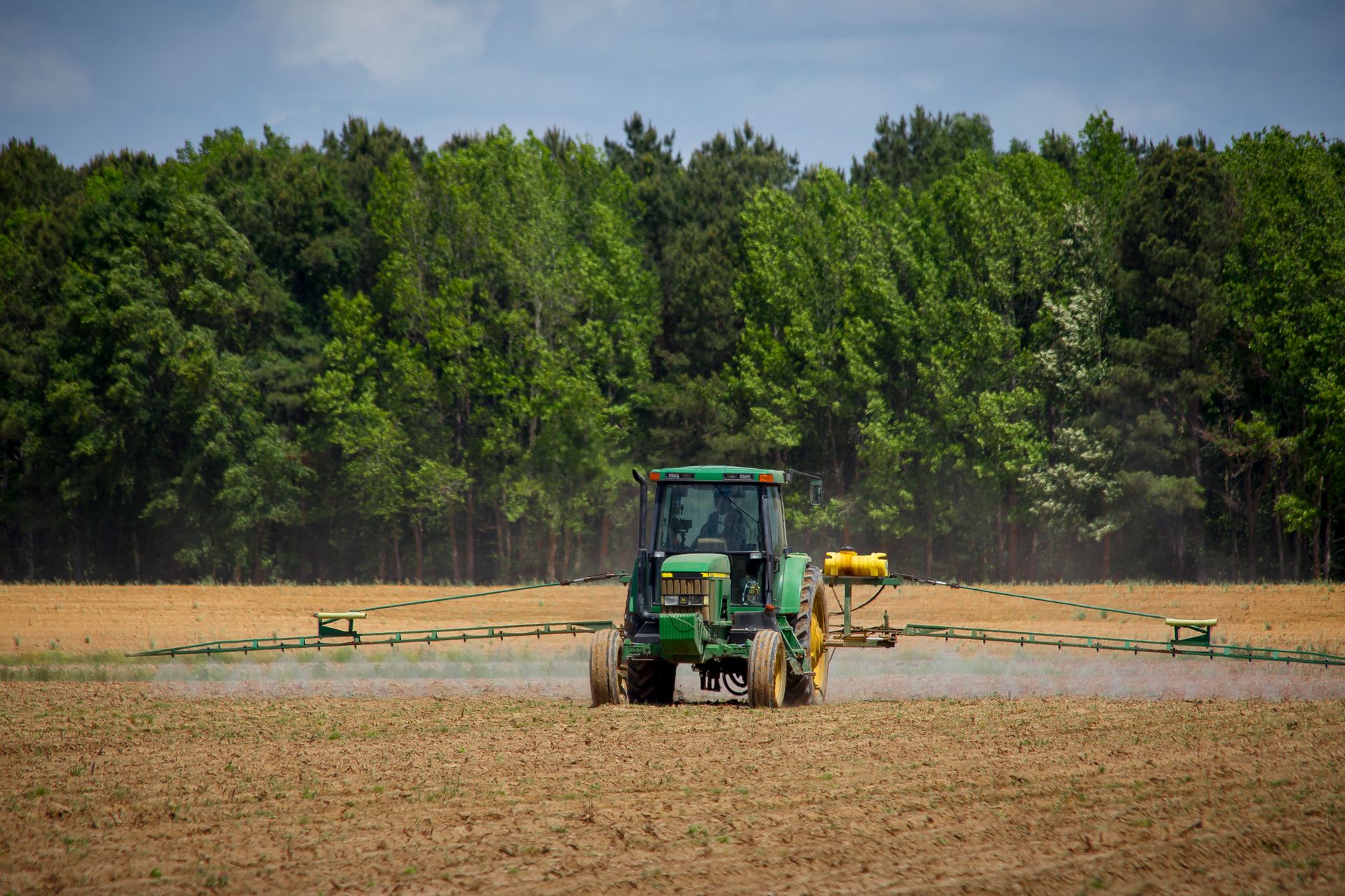
John Deere's acquisition of GUSS Automation, a manufacturer of driverless orchard sprayers, landed so quietly last September that most of the agtech press missed it. But that deal and Growcer's purchase of Freight Farms in the same quarter (Q3 2025) represent something larger than normal M&A noise: they signal the structural death of the standalone agtech unicorn and the rise of a different model, where autonomy gets bolted onto existing equipment and distribution rather than launched as a new hardware category. That shift is now documented in capital flows. The Crunchbase sector snapshot published May 13, 2026, shows agtech startups have raised $1.4 billion through May 7 this year. The number itself is anodyne, it puts the sector roughly on pace with 2024 and 2025. What matters is what that capital is actually funding, and the answer inverts the narrative of the last four years.
Agtech AI has moved from predictive to agentic. The phrase appears in Crunchbase's analysis directly: 'The focus is no longer strictly on collecting data, but on autonomous orchestration, closing the loop between digital insight and physical action on the farm.' That is not a semantic shift. Predictive AI, soil moisture sensors feeding machine learning models to recommend irrigation timing, created a data business. An operator still had to act on the recommendation. Agentic AI automates the action itself: the system reads the soil, diagnoses the problem, and closes the valve or deploys the spray without human decision in between. John Deere's See & Spray technology already covers 5 million acres in North America with AI-powered nutrient deficiency detection. That is not a pilot. That is infrastructure.
The mechanics of this transition explain why consolidation is now the preferred exit. Building an agentic system requires integration with legacy equipment, tractors, sprayers, combines, field sensors, that operate on closed protocols and proprietary datastreams. John Deere owns the tractor install base. GUSS Automation owned the autonomy stack for driverless sprayers but had no customer acquisition path to farmers. The acquisition erased that friction. GUSS gets manufacturing scale and dealer relationships; Deere gets an autonomous orchard layer it would have taken five years and $200 million in internal R&D to build. For a venture-backed agtech startup without either an install base or deep integration leverage, that calculus is terminal. You either get acquired into a player with distribution, or you die competing on price against one.
The capital numbers confirm this sorting. Funding concentration has become extreme: March 2026 alone saw $220 million raised, while prior months saw zero disclosed deals reported. The median monthly capital across the full year is just $7 million. This is not a healthy broad market, it is a few large rounds landing in ventures with defensible positions, Indian startups raising significant capital (Arya Collateral, WayCool, and Varaha took three of the 11 largest deals YTD), and the long tail of single-digit-million raises going silent or being acquired. The 2021 peak, $10.5 billion across 1,419 deals, was a financing bubble disguised as a market. Most of those recipients had no path to real-world traction without consolidation capital or an explicit acquisition target.
Who wins from here is now clear: equipment OEMs and platform players with existing farmer relationships. John Deere, CNH Industrial (Case IH, New Holland), AGCO, Trimble, these firms can acquire autonomy layers, fold them into their installed base, and scale deployment across millions of acres in a quarter. The startup that built the agentic core gets acquired; the startup that owns the distribution relationship gets richer. For investors, this means the next 18 months will be defined not by funding rounds but by which agentic-stack acquisitions land and how fast John Deere's See & Spray expands beyond nutrient deficiency into full-workflow autonomy. The exit door is open only for startups with defensible tech that plays within OEM roadmaps. Everyone else is a feature that gets flattened into a larger product.
Watch three markers: First, the speed of See & Spray deployment beyond North America, expansion into Europe or Asia signals whether Deere's acquisition strategy is working at scale. Second, the next major acquisition by a tier-one OEM outside John Deere; if CNH or AGCO acquires an autonomy play in the next six months, consolidation has become the industry standard exit. Third, whether Indian agtech capital concentration (three of 11 largest deals) produces actual field deployment or remains financial arbitrage on cheaper local funding. That will tell you whether agtech's autonomy inflection is global or trapped in Western equipment infrastructure.