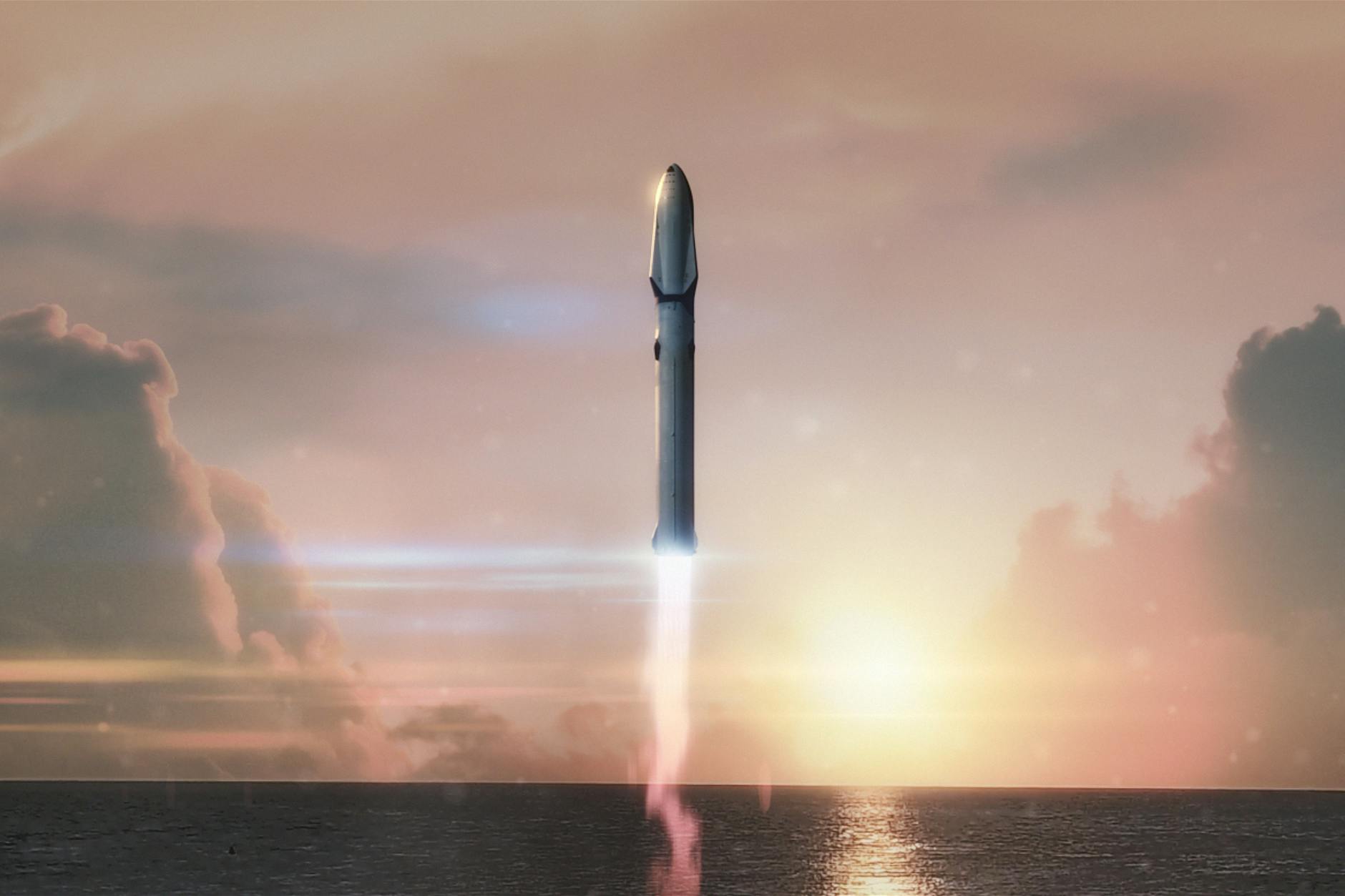
The booster named 'Never Tell Me the Odds' sat on the launch stand at Cape Canaveral Space Force Station on the morning of April 16, 2026, carrying seven BE-4 engines that had already flown once. Seven engines, 20 seconds of fire, 1,145 UTC. Blue Origin's first attempt to refly a New Glenn first stage. Nothing unusual about the test itself. The significant thing is what it represents: the company is now betting real hardware on the idea that it can turn around a 188-foot-tall booster in 157 days and send it back uphill without a complete rebuild. That number—157 days—tells you everything about where Blue Origin actually stands.
New Glenn is a 320-foot-tall heavy-lift vehicle designed to carry 45 metric tons to low Earth orbit and 13 tons to geostationary transfer orbit. It is purpose-built for reuse. The first stage is designed to fly at least 25 times. Blue Origin has been developing the rocket since 2012. SpaceX's Falcon 9 first reflew a booster in 2017 and has since routinely turned them around in 30–50 days, with the best flights seeing 25+ reflights per core. The competitive frame is obvious: reusability only matters if you can do it faster and cheaper than the alternative. Right now Blue Origin is flying the booster for the second time, which means nothing about turnaround has been proven. The 157-day delta between NG-2 (December 2025) and NG-3 (April 2026) is not engineering maturity. It is a first-time attempt at refurbishment. Watch what that number looks like for NG-4. That will tell you whether Blue Origin has actually solved the problem or simply built the first one, inspected it carefully, and put it back in the sky.
The payload is AST SpaceMobile's BlueBird 7, a 6,100-kilogram Block 2 satellite. The satellite carries nearly 2,400 square feet of communications arrays—previously the record was 693 square feet on BlueBird 1 generation satellites. The block 2 design supports 10 GHz of processing bandwidth and peak speeds of 120 Mbps per coverage cell. AST is aiming to deploy 45 to 60 satellites by the end of 2026, which means BlueBird 7 is payload number 7 of a 45–60 unit constellation built to provide direct-to-smartphone cellular broadband across the United States. The Federal Aviation Administration listed the NG-3 mission on its operational manifest for Friday, April 17, with a launch window from 6:45 a.m. to 12:19 p.m. EDT from Launch Complex 36. Backup window is April 18. If the hot-fire data looks good—and if weather and Range holds—NG-3 could lift off within 48 hours of writing this.
The immediate context is two-fold. First, Blue Origin CEO Dave Limp disclosed in an April 13 post that the refurbished booster carries all seven new engines, not reused units. The company also tested thermal protection upgrades on one of the engine nozzles. This is not a full reflew of the same booster; it is a structural refly with new powerplants and selected subsystem upgrades. Second, three days before the hot fire, the U.S. Space Force announced it had selected Blue Origin to pursue a West Coast launch facility at Vandenberg Space Force Base—Space Launch Complex 14—giving New Glenn the high-inclination orbit capability needed to compete for government payloads. That same month, Blue Origin was awarded a National Security Space Launch Phase 3 Lane 2 contract with an anticipated value of $2.4 billion for seven flights. The contract assumes booster reuse will work. The Vandenberg facility assumes booster reuse will work. The entire business case assumes booster reuse will work.
Who wins and who loses depends entirely on execution. If NG-3 lands successfully on the Jacklyn recovery barge on April 17, AST SpaceMobile's manifest becomes real and Blue Origin's cost structure stops being theoretical. If the booster is lost or heavily damaged, AST's 45–60 satellite 2026 target becomes a question mark—the company indicated it would rely on SpaceX for additional capacity, but SpaceX's manifest is already full. Blue Origin wins outright on this mission only if the booster lands in good enough shape to reduce the refurbishment time below 157 days for the next flight. That is not a dramatic threshold. That is the floor. SpaceX has trained the entire industry to expect 40-day turnarounds. 157 days is a headline because it is real progress against a standing structure. It is not progress against the actual cost curve of launch reusability.
Here is the direct read: New Glenn's first booster reuse attempt is real hardware proof, and Blue Origin has earned the right to be taken seriously as a reusable launch company. The hot fire happened. The booster is ready. The launch window is open. But 157 days is four times longer than SpaceX's average, and the company replicated all seven engines instead of reusing them, which means the actual unit cost benefit of reuse is smaller than the marketing materials suggest. If Blue Origin can get to 60–90 day turnarounds by the end of 2026, the company is a genuine competitor. If the number stays above 120 days, New Glenn becomes a heavy-lift option for customers who value payload capacity over cadence, and AST SpaceMobile becomes dependent on SpaceX for the constellation velocity it promised. The April 17 launch window is not the inflection point. The turnaround time on NG-4 is.
Watch three things: (1) Does the booster land successfully on April 17 or 18, and does it require major structural repairs? (2) What is the refurbishment timeline for NG-4, scheduled for later in 2026? (3) How many Blue Moon uncrewed lander missions does Blue Origin actually conduct in 2026, given that New Glenn is the only vehicle that can carry the 45-ton-class payload to the Moon? Blue Origin has promised one Mark 1 uncrewed flight and hopes to support NASA's Artemis III in 2027. If NG-3 lands and NG-4 launches, Blue Moon becomes credible. If either mission fails or delays significantly, Blue Origin's government business becomes contingent on SpaceX mission success, which is a commercial and political problem.