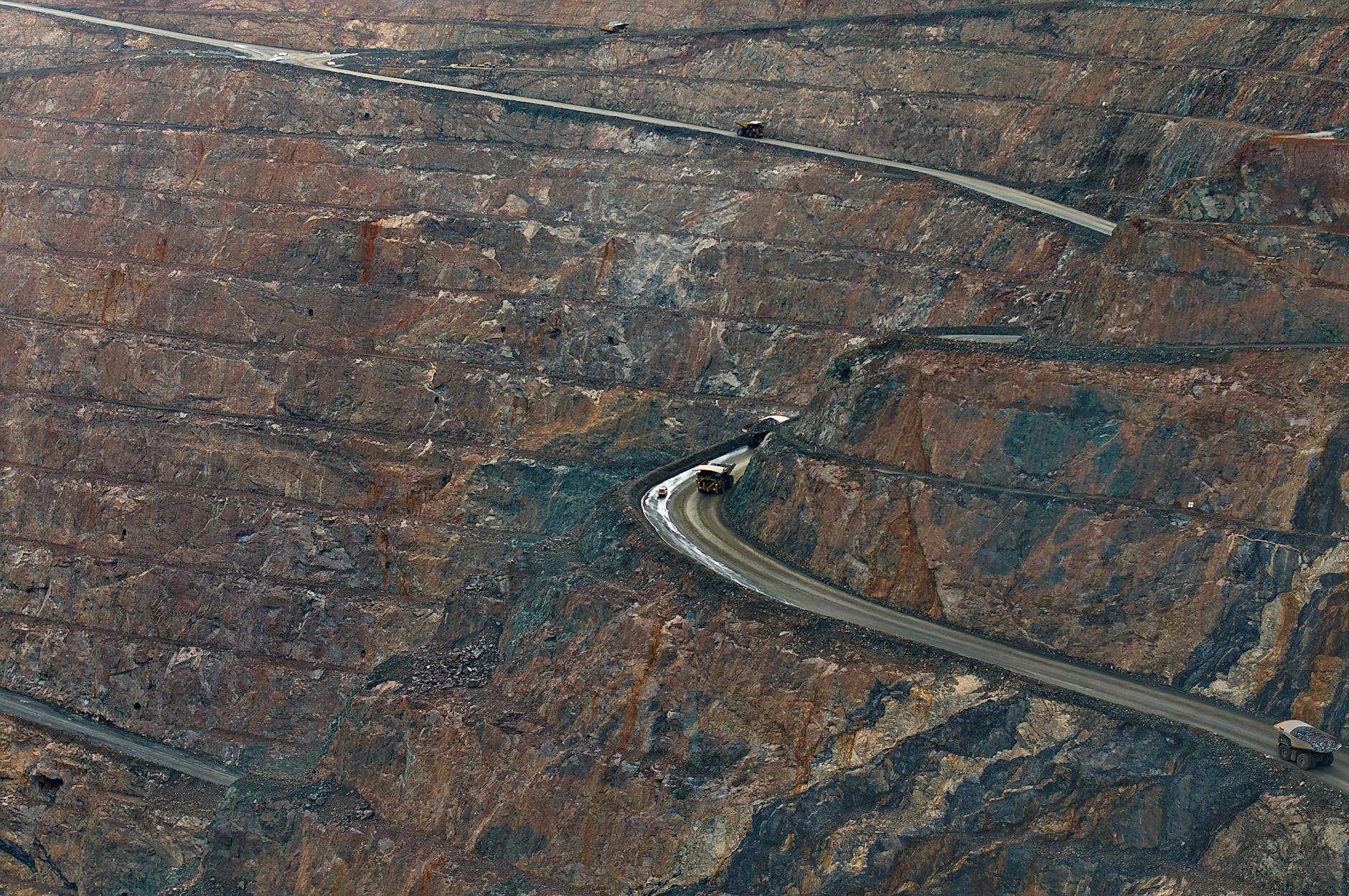
A Chinese autonomous mining equipment maker is moving into Western markets this year. CiDi, listed on the Hong Kong Stock Exchange and the third-largest player in China's autonomous mining truck market with 12.9% market share, expects overseas deployments to accelerate in 2026, according to a Reuters report published July 24. The move matters because CiDi is the first credible Chinese OEM entering global autonomous mining at scale, a category that has been locked down by Caterpillar, Komatsu, and Epiroc for the past five years. Until now, the competitive story in autonomous mining has been Western incumbents versus each other. Now there is a third player, with lower manufacturing costs and no Western supply chain dependencies, entering the market precisely when mining operators are under maximum margin pressure.
Global miners are compressed on all sides right now. The Bitcoin network hashrate sits at 872.4 EH/s with fees at 1 sat/vB across all priority tiers, an ultra-low-fee environment that has already forced hardware efficiency below 10 joules per terahash for the first time in 2026. That same margin compression is hitting hard-rock mining. Copper prices have stabilized below $9,000 per ton, gold is off its December highs, and lithium spot prices remain in a buyer's market. When operators face simultaneous pressure on commodity prices and electricity costs, equipment capital expenditure becomes the next lever to pull. Autonomous systems promise 15 to 25 percent labor cost reduction on open-pit operations and improved asset utilization, two variables that move the needle on unit economics. CiDi's entry signals that equipment suppliers are now competing on total-cost-of-ownership, not just feature parity with incumbents.
The mechanics of CiDi's expansion reveal why timing favors a challenger. CiDi operates an asset-light model, selling hardware and software while leaving manufacturing to partner truck and equipment makers, without the upstream supply chain dependencies that Western OEMs carry. Caterpillar and Komatsu both rely on Nvidia and other GPU suppliers for autonomous control systems; CiDi builds its own. That vertical integration is not novel, it is how Chinese equipment makers have undercut Western suppliers in solar manufacturing, EV batteries, and semiconductor fabrication. What is novel is applying it to autonomous mining at a moment when Western incumbents are still selling single-unit autonomous systems to pilot sites. CiDi has already deployed more than 1,700 autonomous vehicles across Chinese mining operations. The overseas entry is not a sales pitch, it is a statement that the pilot phase is over and the fleet-upgrade phase has begun.
Where CiDi secures its first Tier-1 overseas customer will determine the competitive impact. If it lands a major Australian or Latin American operator, the two regions where autonomous adoption is advancing fastest, it breaks the incumbent lock on equipment margins and forces Caterpillar and Komatsu to defend market share through price competition rather than feature differentiation. Australia is the test market; Gold Fields' commissioning of three Liebherr ultra-class excavators at St Ives Mine in Western Australia on July 24 signals that equipment upgrades are accelerating. Liebherr's announcement is about fleet refresh, but CiDi's overseas push is about fleet replacement. That is a different sales conversation, and it moves faster.
The risk to Western OEMs is not immediate but it is structural. CiDi does not need to match Caterpillar's installed-base relationships or Komatsu's service networks to win. It needs one large customer to validate the technology overseas, and then the cost advantage compounds. A 20 to 30 percent price discount on autonomous haul trucks, easily achievable given CiDi's lower manufacturing overhead, becomes a 15 to 20 percent advantage on five-year total cost of ownership. That margin is meaningful enough to shift procurement conversations at operators with capital budgets in the hundreds of millions.
Watch three markers. First, CiDi's first confirmed overseas customer and the geography of deployment, Australia would signal the most competitive threat. Second, the pricing CiDi offers relative to incumbent systems in that region; if it undercuts by 25 percent or more, it validates the cost advantage and accelerates competitive response. Third, whether Caterpillar or Komatsu respond with price cuts or with new automation features; incumbents almost always choose features first, which buys time for CiDi to establish customer relationships before the price war begins. The overseas expansion has not landed a contract yet. The Reuters report confirms intent. But intent from a vertically integrated supplier with more than 1,700 units already deployed is not hype, it is momentum.