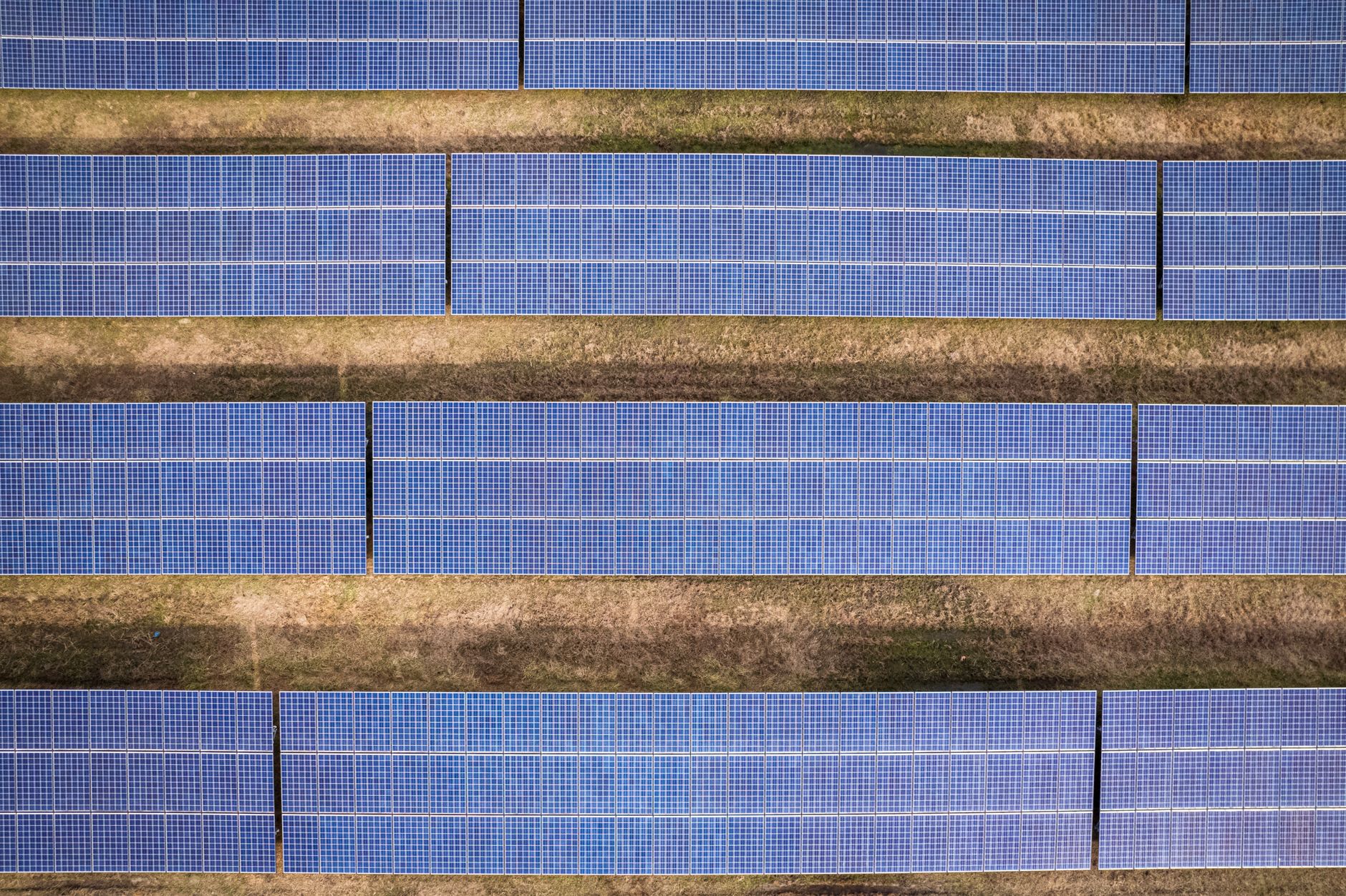
Cold Creek's financial close is not primarily a project milestone — it is a signal that the IRA's accelerating phase-out clock has become the dominant structuring force in U.S. utility-scale solar and storage finance. On March 24, 2026, Doral Renewables LLC closed approximately $900 million in financing commitments for its Cold Creek Solar + Storage project in Schleicher and Tom Green Counties, Texas, and issued a Notice to Proceed. The 430 MWac solar generation and 340 MWh battery energy storage hybrid project is Doral's largest Texas venture and its second-largest development after the 1.3 GW Mammoth Solar complex in Indiana. The transaction's structure — combining construction-to-term debt, a PTC Transfer Agreement, and supplemental letter-of-credit facilities — illustrates how the financing playbook for renewables has been fundamentally rewritten since July 2025.
The arena in which Cold Creek competes is the largest single-year U.S. grid build in over two decades. EIA data from February 2026 projects 86 GW of new utility-scale generating capacity will come online in 2026, nearly doubling the 53 GW installed in 2025. Battery storage leads the charge: developers plan to add 24 GW of utility-scale BESS in 2026, up from a record 15 GW in 2025, with the U.S. having added more than 40 GW cumulatively over the prior five years. Texas is the dominant theatre, accounting for 53% — or 12.9 GW — of planned 2026 storage additions, followed by California at 14% (3.4 GW) and Arizona at 13% (3.2 GW). In solar, Texas also leads, representing 40% of planned 2026 utility-scale additions. The dominant developers operating at this scale include NextEra Energy Resources, Intersect Power, Invenergy, Ørsted, and a tier of mid-size IPPs — of which Doral, with a nearly 18 GW development portfolio across 15 states, occupies the upper-middle band.
The Cold Creek financing stack is forensically instructive. MUFG served as lead arranger on a syndicate that includes Santander, HSBC, Ally, and IDB. The debt facilities comprise more than $400 million in construction-to-term financing and approximately $35 million in tax equity bridge loan financing, alongside approximately $55 million in letters of credit. Separately, Doral secured a 10-year PTC Tax Credit Transfer Agreement with an investment-grade rated corporate buyer, structured to monetise $360 million in Production Tax Credits — the identity of the corporate buyer has not been disclosed publicly. In a parallel transaction, also closed in March 2026, Doral secured approximately $525 million in letter-of-credit facilities to support sponsor equity across its broader portfolio, a move that signals active pipeline management beyond Cold Creek. Commercial operation is targeted for summer 2028. (Technical note for grid operators: the project's 430 MWac / 340 MWh configuration implies a storage-to-generation ratio of roughly 0.79 MWh per MWac — consistent with ERCOT ancillary services dispatch profiles rather than multi-hour seasonal arbitrage.)
Three convergent forces explain why this close happened in March 2026 rather than 12 months earlier or later. First, the legislative forcing function: on July 4, 2025, President Trump signed the One Big Beautiful Bill Act, which accelerated the phase-out of wind and solar tax credits; under the new law, projects over 1.5 MW must begin physical construction of a significant nature by July 4, 2026 to qualify. Cold Creek's March 2026 NTP places it squarely inside that window, but with minimal margin. Second, the maturation of the PTC Transfer mechanism, introduced under the Inflation Reduction Act of 2022, has unlocked a far broader universe of tax credit buyers — investment-grade corporates seeking direct cash purchase of credits, bypassing the traditional tax equity partnership structure that historically constrained deal velocity and required a narrow set of institutional participants. Third, ERCOT's energy-only market architecture has proven uniquely hospitable to storage monetisation: absent a statewide storage mandate, Texas developers have built business cases on ancillary services revenues and energy price volatility, with load growth from data centre electrification providing a structural demand floor. The Q3 2025 record of 10.9 GW (33.7 GWh) of U.S. storage additions in a single quarter, per Morgan Lewis data, confirms that capital and permitting pipelines had already cleared their bottlenecks before the legislative deadline sharpened.
The competitive implications of Cold Creek's close sort cleanly across the value chain. Doral strengthens its position in the Texas IPP tier, where its ability to assemble a five-bank syndicate led by MUFG and execute a $360 million PTC Transfer in a compressed timeline demonstrates financing execution capability that mid-tier developers without established lender relationships cannot easily replicate — this shifts pricing power on debt terms toward developers with proven syndicates. MUFG's lead arranger role reinforces the Japanese megabank's positioning in U.S. renewables project finance, where it competes directly with JPMorgan, BofA, and Wells Fargo for mandates. The PTC Transfer market is where the second-order effect is most consequential: as more developers race the July 4 deadline, competition for investment-grade corporate PTC buyers will intensify in Q2 2026, compressing the implied discount rate at which credits transfer and potentially narrowing developer economics on projects that close later in the window. Traditional tax equity providers — including large insurance companies and regional banks that historically dominated renewable tax equity — face continued structural displacement as PTC Transfers require less legal complexity and shorter transaction timelines. Developers who have not yet secured a PTC Transfer counterparty face a narrowing window and rising counterparty selectivity.
Our read: the Cold Creek transaction is the leading edge of a Q2 2026 financing surge that will stress-test every link in the renewables capital stack simultaneously. Our hypothesis is that the July 4, 2026 deadline will produce a material dispersion in project outcomes — not between projects that do and do not get built, but between projects that close financing before April 30 and those that attempt to close in May and June, when lender bandwidth, PTC Transfer counterparty capacity, and construction contractor availability will all be simultaneously constrained. This would confirm what Cold Creek's March close implies: that the developers with first-mover advantage on this deadline cycle are not simply being prudent, they are capturing a structural option on financing terms that will deteriorate as the window narrows. The disconfirming scenario is a Treasury guidance clarification that broadens the 'physical work of significant nature' standard, providing more projects with qualifying footing and relieving deadline pressure — watch the Latham and Watkins tracker on Treasury's OBBB construction start guidance for any such development.
Decision-makers should track four specific indicators. First, the pace of NTP issuances and financial closes in April and May 2026: if the market sees more than 15 GW of utility-scale solar and storage projects issue NTPs before June 1, it will confirm that the deadline is compressing the entire financing calendar and validate the lender-bandwidth thesis; EIA's preliminary generator inventory updates, published monthly, are the cleanest data source. Second, the FERC paper-hearing replies due April 17, 2026 on the PJM co-location order: FERC's framing of large-load interconnection rules in PJM will be read as a signal for ERCOT and other markets, with direct implications for how Cold Creek and comparable Texas solar-plus-storage projects structure their data centre offtake agreements. Third, Cold Creek's ERCOT interconnection filing and capacity registration, expected in H1 2027, which will serve as the first hard commissioning milestone confirming whether the summer 2028 COD target is on track. Fourth, the realised 2026 BESS addition total against EIA's 24 GW forecast: given that 10.9 GW was added in Q3 2025 alone, tracking whether 2026 actuals outpace projections — or whether permitting and supply chain bottlenecks introduce slippage — will determine whether Texas's 12.9 GW target is absorptive capacity or an aspirational ceiling.