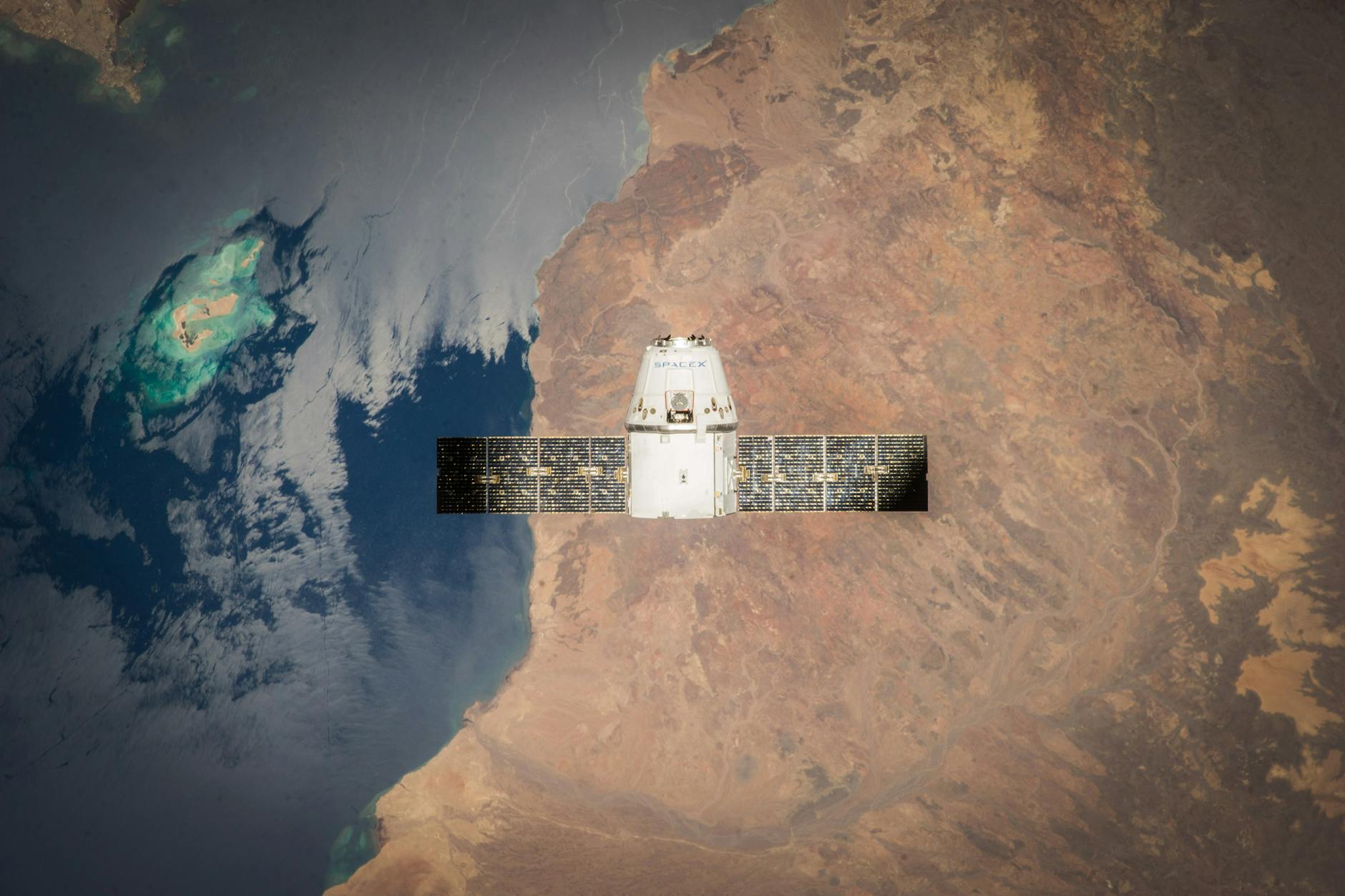
On May 3, 2026, a Falcon 9 rocket lifted off from Vandenberg Space Force Base carrying six satellites that did not belong to SpaceX, Amazon, or any established constellation operator. They belonged to EarthDaily Analytics, a company that did not exist five years ago, and they landed in orbit with all systems nominal. Solar arrays deployed. Telemetry locked. Power positive. By the end of the week, those six satellites had established contact with ground stations. They worked.
This is not a press release claim. This is hardware on telemetry. EarthDaily Analytics has now deployed 14 operational multispectral Earth observation satellites into low Earth orbit across two launches in the past few months. Each satellite carries 16 imaging systems across 22 spectral bands, designed to work as a coordinated constellation that captures the same patch of Earth repeatedly, day after day, feeding analysis-ready data into AI pipelines. The constellation is on a path to 20 satellites or more. This is no longer a roadmap. It is a constellation.
Running in parallel, on April 27, ULA's Atlas V rocket lifted off from Cape Canaveral carrying 29 Amazon satellites, and set a record that people in the launch industry have been watching for: the heaviest payload the Atlas V family has ever flown. Eighteen tons of cargo. That is not a minor credential. The Atlas V is not a new rocket. It has been flying since 2002. The fact that ULA just now hit its payload record on an Amazon mission tells you something important about what happened to launch and constellation architecture in the past three years. Amazon did not ask for the record. ULA just delivered it, week after week, on a schedule that matters.
The numbers matter more than the records. Amazon now has 270 satellites in low Earth orbit. ULA has lifted 168 of them across six dedicated missions. The next mission, Amazon Leo 7, is scheduled for May 22, 2026, from the same pad. Amazon intends to have half its planned 3,236-satellite constellation in orbit by the end of July 2026. That is not a target. That is a statement of what the company is building for, right now, with launch cadence already locked in. This is the cadence that Starlink established, that Kuiper is chasing, and that every other constellation operator is trying to rationalize against. ULA is now in the middle of it, not as a secondary player, but as a primary engine.
EarthDaily is a different animal entirely. The company is not building an internet constellation. It is building a measurement instrument. The satellites carry cameras, not antennas. The economics are not measured in megabits per second, they are measured in spectral resolution and revisit frequency. The margin lies in analysis-ready data, not raw bandwidth. Don Osborne, EarthDaily's CEO, said it directly in the launch announcement: 'Most Earth observation systems were built to capture images. We built EarthDaily to measure change.' That distinction matters. A camera that flies every day and delivers calibrated multispectral data to an AI system is not a satellite. It is a sensor platform. It is infrastructure for climate intelligence, agricultural monitoring, precision land-use tracking, and supply-chain visibility. The customer base is not government agencies buying imagery licenses. It is companies that need to know what changed in their supply chains, their assets, or the land they operate on, with a frequency and certainty that archive imagery cannot provide.
The real story is competitive pressure and proved execution. EarthDaily's success on orbit reduces execution risk for the entire commercial EO constellation segment, which includes Planet Labs, Maxar's recent acquisitions, and smaller operators. Successful deployment means these companies are not waiting for perfect funding or perfect technology; they are launching hardware, iterating on orbit, and building toward scale. At the same time, ULA's demonstrated ability to handle 18-ton payloads and sustain a monthly launch cadence for Amazon means that constellation operators who need heavy-lift capacity no longer have a single-source dependency. That matters for Amazon's own risk profile, and it matters for the entire market. Launch competition at scale is real. The constraint is no longer launch vehicles. The constraint is now capital, spectrum, and whether the constellation economics actually close.
The harder read: EarthDaily's constellation will prove valuable if and only if the company can convert data into revenue faster than the cost of deploying and maintaining a 20+ satellite constellation inflates. The satellite cost per unit is coming down, integration costs in Florida and elsewhere are competitive now, but the operational lifetime and the refresh rate create a replacement cycle that demands continuous revenue. Amazon can absorb that risk because broadband internet is a proven business model at scale. EarthDaily is betting that daily, calibrated multispectral data has enough margin in climate tech, agriculture, and supply-chain visibility to support the constellation. That is a different bet. It is a real bet, backed by real hardware now in orbit. But the risk is not launch. It is revenue.
Watch three things in the next 60 days. First, Amazon Leo 7 launches on May 22, if ULA executes that launch on time, the schedule is no longer a hope, it is a rhythm. Second, EarthDaily announces customer deployments or revenue contracts; if those come, the data-value thesis moves from theoretical to proven. Third, Argotec's integration facility in Florida delivers additional satellites to orbit; the company manifested seven HEO MicroSats on the same Falcon 9 as EarthDaily, which means constellation operators are learning to share rideshare capacity and manage multi-constellation deployments at scale. Any one of those three will confirm that the infrastructure layer for the next-generation space economy is no longer experimental.