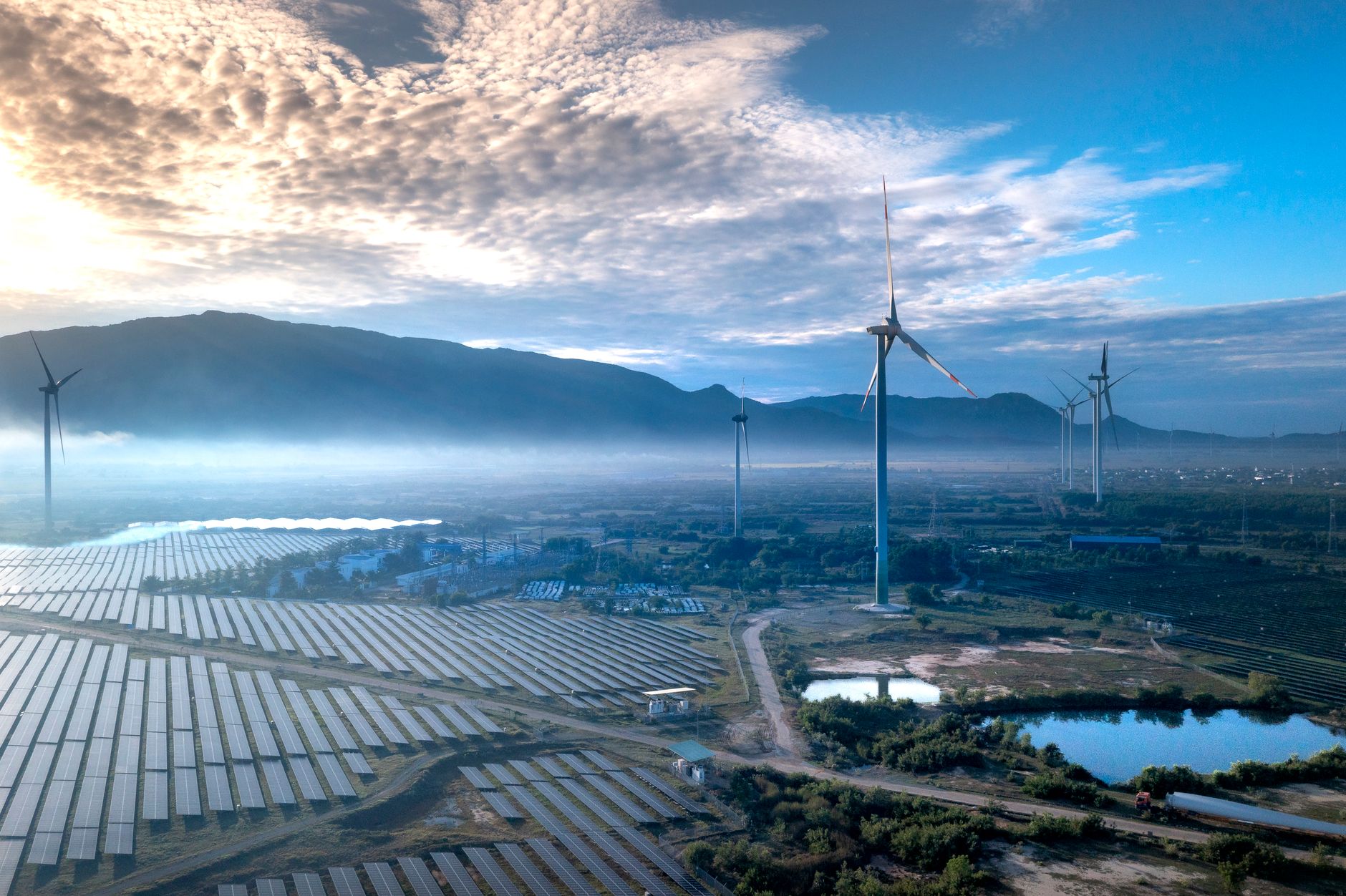
The U.S. renewable buildout has crossed a threshold that reframes the entire competitive structure of power generation: wind and solar are no longer a growth story at the margin but a system-defining supply source that now sets the terms for every other technology on the grid. The EIA's Electric Power Monthly, released March 24, 2026 with data through January 31, confirmed that wind and solar together generated 760,000 GWh in 2025 — a record 17% of total U.S. electricity generation — and that developers plan to add 86 GW of new utility-scale capacity in 2026, which would be the largest single-year addition since 2002. The structural implication is direct: with renewables and storage projected to account for 93% of all new capacity, the marginal unit of generation entering the U.S. grid is now, by default, clean. That is no longer a forecast. It is a measured fact.
The arena being contested is the largest electricity market in the world, and the pace of change has accelerated sharply. After nearly 15 years of flat demand, net energy for load grew at an annual rate of 1.7% between 2020 and 2025, driven by data center buildout and industrial electrification concentrated in Texas and the Mid-Atlantic. Against that demand backdrop, the five dominant technologies competing for the 2026 build year are utility-scale solar (43.4 GW planned), battery storage (24.3 GW planned), onshore wind (11.8 GW planned), offshore wind (1.5 GW across Vineyard Wind 1 and Revolution Wind), and natural gas (6.3 GW planned). Solar leads the pipeline at 51% of total additions; battery storage follows at 28%. Natural gas, which once defined the 'reliable' baseline against which all variable renewables were measured, is entering 2026 as a rounding error in the capacity addition calculus.
The March 24 EIA release establishes the forensic baseline. In 2025, solar capacity growth outpaced wind by a factor of more than ten: utility-scale PV rose 34% while wind grew 3%, with wind generating 464,000 GWh and utility-scale solar generating 296,000 GWh. Small-scale solar contributed an additional 93,000 GWh, up 11% from 2024. Utility-scale battery storage added 15,788.8 MW of new capacity over the prior 12-month period — a figure that will be tested against the 24.3 GW 2026 target, which would itself represent a 54% jump from the record set in 2025. The single largest project expected online in 2026 is Tehuacana Creek 1 in Navarro County, Texas — 837 MW of PV paired with 418 MW of co-located battery storage — a project that alone exceeds the entire installed solar capacity of most U.S. states a decade ago. (Capacity factors reported by EIA for 2025: nuclear 91.0%, natural gas 58.4%, coal 48.7%, wind 34.2%, utility-scale PV 24.4% — the dispatchability gap remains real, but battery pairing is the acknowledged structural response.)
Three convergent forces explain why the 2026 pipeline is shaped the way it is. First, the solar cost curve: utility-scale PV installed costs have fallen consistently, and the 60% increase in planned solar capacity additions from 2025 to 2026 reflects procurement decisions made 18 to 36 months ago when power purchase agreement prices continued to clear at levels that made solar the default technology selection for developers. Second, battery storage economics have crossed the threshold where co-location with solar is standard project design rather than a premium option — the 418 MW storage pairing on Tehuacana Creek 1 is representative, not exceptional. Third, state-level policy mandates are amplifying the federal signal: Illinois enacted the Clean and Reliable Grid Affordability Act in January 2026, directing utilities to install 3 GW of utility-scale storage by 2030, joining California and New York as states with enforceable storage targets that create demand floors independent of federal policy. The precedent set by FERC Order 2023 in 2023 — reforming interconnection queue processes — has begun to move through the system, though the backlog remains the dominant structural bottleneck.
The competitive implications stratify cleanly across the value chain. Solar module manufacturers and EPC contractors face a 2026 demand surge that will test supply chains, particularly given tariff uncertainty on imported panels; U.S.-manufactured module capacity remains well below the 43.4 GW annual installation target. Battery storage integrators — led by Tesla Energy, Fluence, and BYD's U.S.-facing operations — are positioned to capture the largest single-year deployment in the technology's history, but Texas concentration (12.9 GW, 53% of all planned U.S. storage) creates execution risk that is geographically correlated. Offshore wind developers Avangrid (Vineyard Wind 1, 800 MW, Massachusetts) and the Skyborn Renewables / Ørsted partnership (Revolution Wind, 715 MW, Rhode Island and Connecticut) both survived Trump administration stop-work orders via federal court rulings — a legal precedent that, if it holds on appeal, effectively establishes that offshore wind permits cannot be administratively revoked without statutory authority. The natural gas sector faces the clearest structural pressure: with only 6.3 GW of new gas capacity planned against 86 GW of combined renewable and storage additions, the marginal economics of new gas construction are deteriorating as storage begins to erode the capacity market premium that justified gas peakers. This shifts pricing power from gas peaker operators to BESS developers in the ancillary services markets of ERCOT and PJM.
Our read: the 86 GW pipeline figure is a commitment schedule, not a guarantee, and the single largest variable is ERCOT interconnection throughput. Texas accounts for 40% of planned solar and 53% of planned battery storage — concentrations that make the annual record dependent on the grid operations and permitting capacity of one ISO. The testable hypothesis is this: if ERCOT monthly generator interconnection reports show commissioning slippage of more than 15% against planned 2026 in-service dates by the end of Q2 2026, the headline 86 GW figure will not be achieved, and the market will need to revise both capacity and storage revenue projections downward. Conversely, if the FERC April 17 PJM co-location deadline produces a workable large-load interconnection framework, the Eastern Interconnection backlog could begin to clear in a way that accelerates the 2027 pipeline beyond current projections. The political headwind — an administration that issued stop-work orders on offshore wind and has signaled continued hostility to federal clean energy incentives — is real but has so far been contained by the federal judiciary. That containment is not permanent; the legal durability of the offshore wind permit framework through the D.C. Circuit is the political risk that is most underpriced in current developer planning assumptions.
Four specific indicators will determine whether the 2026 record materializes and what competitive structure emerges from it. First, ERCOT's monthly generator interconnection status report for April 2026, due in early May: a commissioning rate below 70% of planned Q1 in-service dates would signal systemic slippage in the Texas battery and solar pipeline. Second, the EIA April 23 Electric Power Monthly release, which will carry February 2026 generation data — the first full month with both Vineyard Wind 1 and Revolution Wind partially online — and updated battery storage installation figures against the 24.3 GW annual target; a February battery storage figure below 1.5 GW would indicate the pace needed to hit 24.3 GW is not established. Third, the FERC April 17 deadline for stakeholder replies in the PJM co-location proceeding: a Commission order that establishes a clear large-load interconnection pathway would materially reduce the structural bottleneck that threatens to cap the 2027 and 2028 pipelines regardless of developer demand. Fourth, the commercial operation date announcement for Vineyard Wind 1: Avangrid has stated all 62 turbines will be fully commissioned in the coming weeks; ISO New England's first full-capacity generation report from the 800 MW project will be the live grid test of whether the offshore wind supply chain can deliver at scale after years of delay.