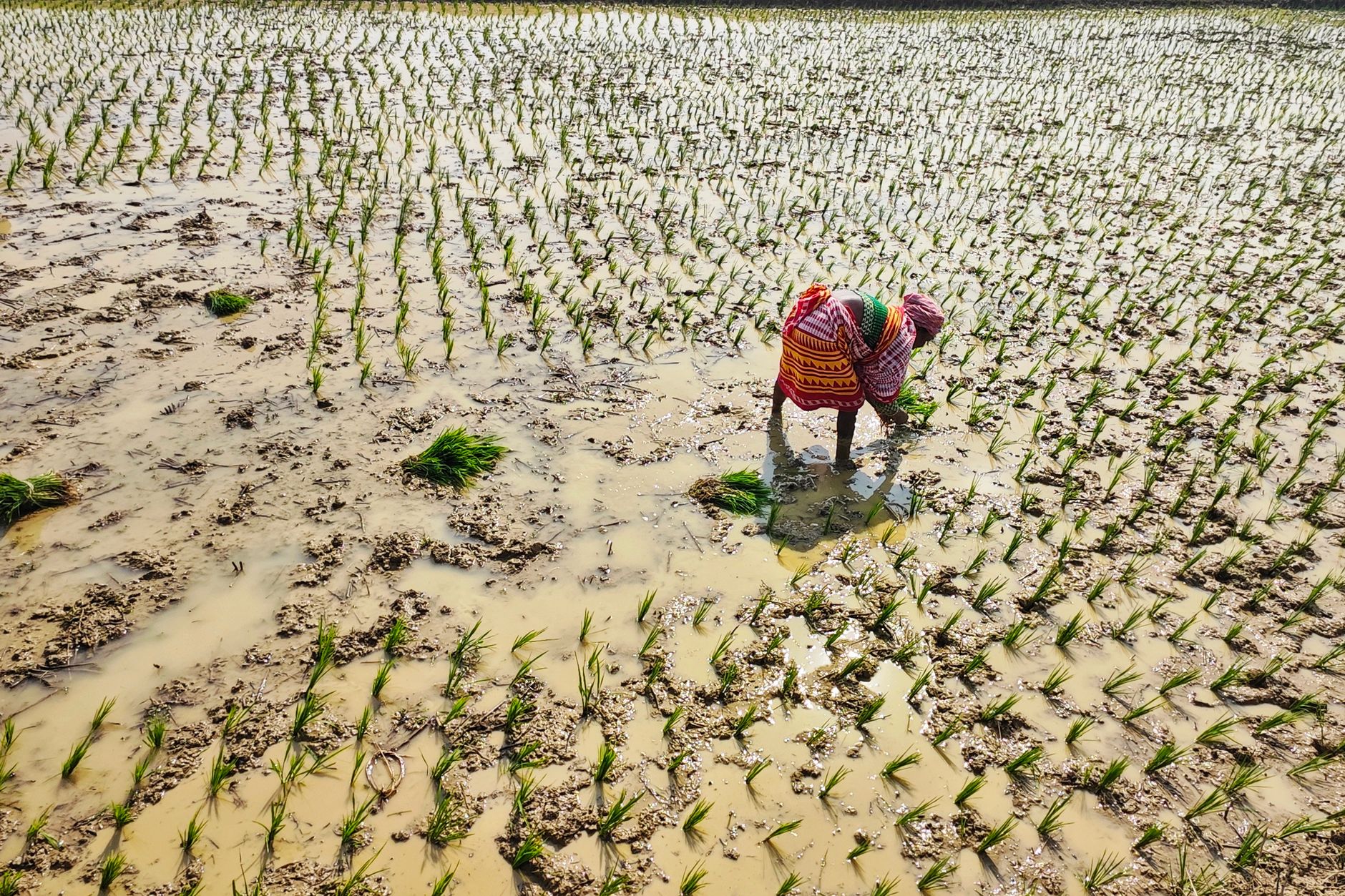
India's Department of Agriculture and Farmers Welfare delivered probabilistic AI monsoon onset forecasts to 3,88,45,214 farmers across 13 states during the Kharif 2025 growing season, according to a press release from the Press Information Bureau and a revised methodological preprint posted to arXiv on March 26, 2026 by a team spanning the University of Chicago, UC Berkeley, IIT Bombay, IISc Bangalore, and Google Research. The forecasts, transmitted via SMS through the M-Kisan portal in Hindi, Odia, Marathi, Bangla, and Punjabi, delivered predictions up to four weeks in advance of local monsoon onset — a lead time that had not been achieved in 150 years of organised monsoon forecasting in India.
The context matters. The monsoon delivers roughly 70.0% of the rainfall needed to water crops and recharge aquifers across the subcontinent, and with nearly half of India's farmland unirrigated, the June–September window is not a seasonal convenience but an existential input. Monsoon behaviour has also been shifting — July, historically the peak month, is now showing declining rainfall totals, while September has grown wetter, and onset and withdrawal dates have drifted in different directions across different regions. The practical effect is that farmers operating on generational intuition are increasingly navigating a system that no longer behaves the way inherited knowledge describes.
The forecasting system works by blending two open-access AI weather prediction models — Google's NeuralGCM, a probabilistic model that generates 32 ensemble members per run, and ECMWF's Artificial Intelligence Forecasting System (AIFS) — with 125 years of historical rainfall data from the India Meteorological Department, covering the period 1901 to 2024. The team tested seven models over nearly 60 monsoon seasons before settling on NeuralGCM and AIFS as the consistent leaders against both AI and conventional benchmarks. A Bayesian 'evolving farmer expectations' statistical layer then translates raw model output into time-varying probabilities of rainy-season onset, calibrated for 2-by-2-degree grid boxes and updated twice weekly. Against a leave-one-year-out cross-validation covering 2000 to 2024, the blended system improved Brier Score by roughly 5.0 to 10.0 percent, improved Ranked Probability Score by 20.0 to 25.0 percent, and increased AUC by 3.0 to 5.0 percentage points relative to static climatology, according to the arXiv preprint. The real-world stress test came in June 2025, when the monsoon stalled over southern India for 20 days — a pause the AI-based model predicted and that no other available forecast system flagged. (ECMWF's AIFS also carries a secondary benefit the paper notes: a roughly 1,000-fold reduction in energy use relative to conventional numerical weather prediction for equivalent forecast runs.) A companion peer-reviewed paper in Meteorological Applications, led by Danny Parsons, David Stern, and Denis Ndanguza, presents a five-step methodology for evaluating satellite and reanalysis rainfall estimates for agricultural climate services, validated against ground stations in Africa and the Caribbean — extending the methodological scaffolding toward the Global South deployments the team is already planning.
The behavioural signal embedded in the data is the detail that will matter most to policymakers and agtech investors. A survey of farmers who received the forecasts found that 31.0% to 52.0% of recipients adjusted their planting decisions, primarily through changes in land preparation and sowing timing, including crop selection and input choice, according to the PIB press release. That range is wide enough to warrant scrutiny — the upper bound depends on self-reported survey responses, which this desk cannot independently verify — but even the lower bound represents a statistically meaningful shift in behaviour across tens of millions of smallholders operating with thin margins and no crop insurance safety net. The Government of Odisha separately partnered with the research team to extend reach to nearly 1,000,000 additional farmers through a voice messaging platform, according to Berkeley News. Catalytic funding for the effort came in part from AIM for Scale, a global initiative backed by the Gates Foundation and the United Arab Emirates.
Prof. William Boos, Professor of Earth and Planetary Science at the University of California, Berkeley and a co-author on the preprint, told Berkeley News: 'Demonstrating that the long lead-time precipitation forecasts made by these AI models are of practical use in a tropical region where people live is a major step forward — no one really knew that before we did this work.' Dr. Pramod Kumar Meherda, Additional Secretary at India's Ministry of Agriculture and Farmers' Welfare, said in the PIB press release: 'This program harnesses the revolution in AI-based weather forecasting to predict the arrival of continuous rains, empowering farmers to plan agricultural activities with greater confidence and manage risks. We look forward to continuing to improve this effort in future years.' Prof. Ramesh Chand, Member of Niti Aayog, India's national planning body, added in the same release that the initiative 'centers specifically on the needs of farmers by providing tailored weather forecasts in easy to understand language and helps them make informed farming decisions.'
For agtech founders and climate adaptation investors, the 2025 pilot answers a question that has haunted precision agriculture for a decade: whether AI forecast improvements that show up cleanly in verification metrics actually change what farmers do in the field. The answer, provisionally, is yes — and the infrastructure to deliver that change already exists in the form of government SMS portals reaching hundreds of millions of registered farmers. The parties most directly affected by what happens next are the smallholder farming communities across South Asia, sub-Saharan Africa, and the Caribbean where the companion satellite methodology paper is already being tested. Amir Jina, Assistant Professor at the Harris School of Public Policy at the University of Chicago and a co-lead on the initiative, said in a statement from UChicago's Institute for Climate and Sustainable Growth: 'Our idea is to see how we can turn this into a generalizable tool — not just for farmers all over the world, but for other use cases.' The quiet lesson here is that the binding constraint on climate adaptation at scale is rarely the science — it is the last-metre delivery infrastructure, and India has just demonstrated that the infrastructure already exists.
Three signals are worth tracking closely. First, watch for a Kharif 2026 launch announcement from India's Ministry of Agriculture, expected April to May 2026, confirming the indigenised successor programme integrating IITM, IMD, and ISRO — IITM's dynamical models have already demonstrated superior skill in simulating local onset and are being folded into the AI blending framework. Second, monitor whether IITM's Bharat Forecast System achieves its target of improving national weather prediction resolution from 12 kilometres to 6 kilometres, which could enable village-level forecast precision and materially expand the granularity of what farmers receive via SMS. Third, track AIM for Scale's pipeline for analogous deployments in other low- and middle-income countries — the Gates Foundation-backed initiative represents the most likely near-term vector for replicating the India model in sub-Saharan Africa, where the companion satellite methodology paper has already been validated against ground stations in 12 locations.