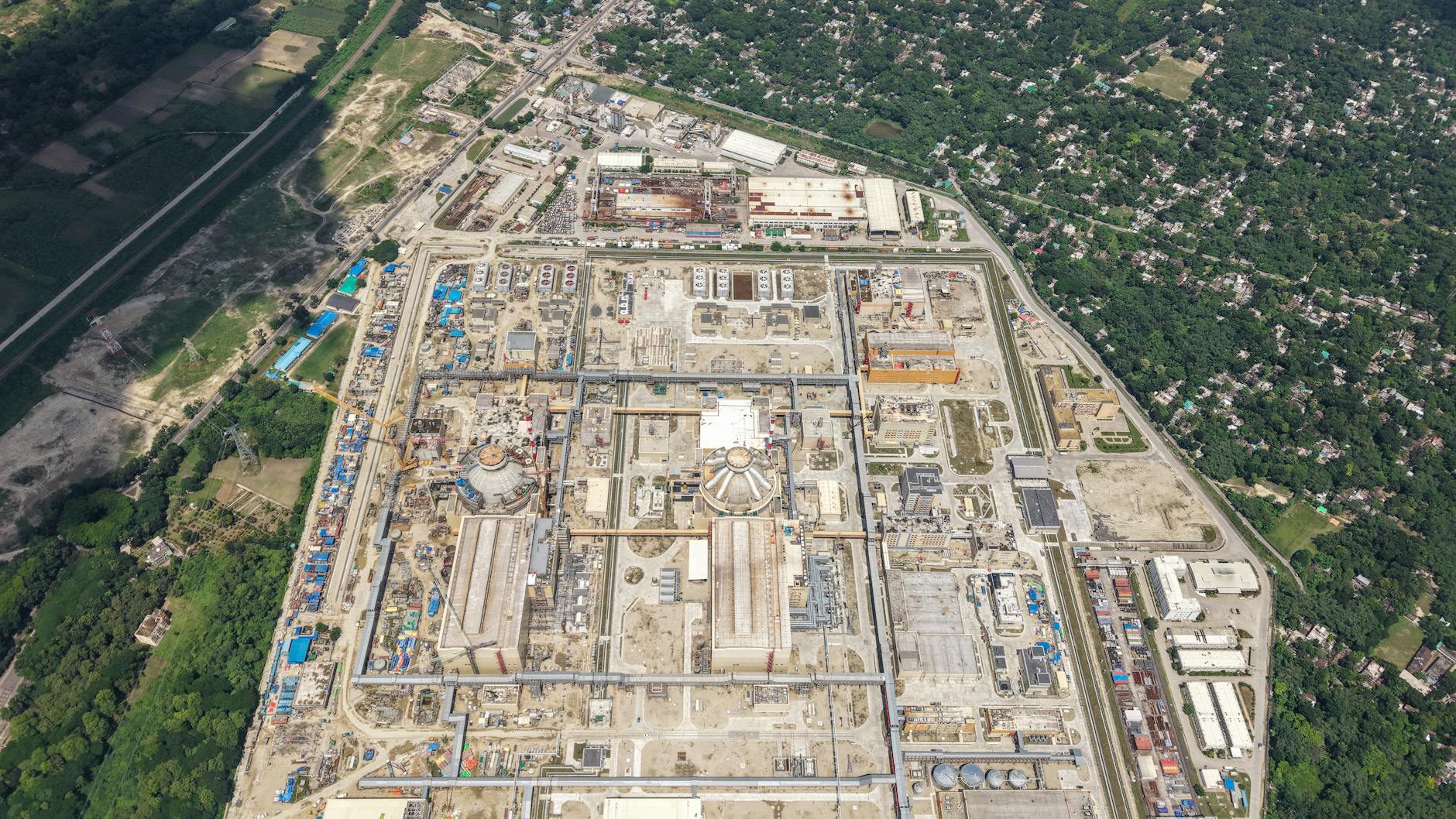
A 2.1-million-pound chunk of reinforced concrete descended 35 metres into the ground at the Darlington site near Toronto on May 1, 2026, lowered within millimetre precision by one of the world's largest crawler cranes. The basemat module, equivalent in weight to three Airbus A380 aircraft, is not the flashy part of nuclear construction. It is the part that makes the whole thing real. Ontario Power Generation just crossed the line from permitting and site prep into actual vertical reactor building construction, the point at which contractors pour money, equipment, and labour into a hole in the ground and cannot walk away without massive sunk cost. For the first time in a G7 country, an SMR is moving from approved design to physical foundation.
Darlington's four GE Hitachi BWRX-300 units will produce 1,200 megawatts of firm electricity once complete, enough to power 1.2 million homes. The total project carries a CAD$20.9 billion price tag (USD$15 billion), with the first unit alone costing CAD$6.1 billion. OPG obtained its construction licence from the Canadian Nuclear Safety Commission in April 2025 and filed for an operating licence in March 2026. The project targets commercial operation in 2030. This matters not because Ontario is building reactors, it matters because Ontario is willing to spend $15 billion on a single utility-scale SMR fleet in a market that has spent the last five years betting everything on battery storage and renewables. That is a different signal about which energy technologies actually solve the grid's structural problem.
The gap between Darlington and every other major SMR project in the Western world is now obvious. NuScale, the U.S. SMR leader, secured NRC approval in May 2025 for its VOYGR-12 design but has not yet begun vertical construction on its demonstration project at Idaho National Lab, it is still in early site preparation. The company has written down that project's economics multiple times and has no utility customer for the first unit. TerraPower's Natrium demonstration reactor in Wyoming is still in licensing review. Westinghouse's AP300 has approval in principle from regulators but no construction contract. Darlington is the only one pouring concrete. The basemat is not a milestone, it is a fact. OPG is building this.
What created the conditions for this became clear in the research brief but bears restating: Ontario faces the same grid pressure as every other North American jurisdiction. EIA data shows U.S. developers plan to add a record 86 gigawatts of new generating capacity this year, overwhelmingly intermittent renewables. Developers also plan to add 24 gigawatts of battery storage in 2026 alone, compared to a record 15 gigawatts in 2025. The math does not work. You cannot reliably serve industrial load or support the grid through winter on renewables plus four-hour batteries at scale. Ontario's government looked at that equation and decided that a 1,200 MW package of firm, zero-carbon, dispatchable baseload power justifies a $15 billion bet. They also looked at the timeline, 2030 grid connection, and concluded it was faster than building new coal plants, less politically toxic than extending coal, and the only way to retire coal on a real schedule. The financing is partially public: CAD$1 billion from Ontario's Building Ontario Fund and CAD$2 billion from the Canada Growth Fund, with the remainder presumably from OPG's balance sheet and potentially export financing.
The winners here are OPG, GE Vernova Hitachi Nuclear Energy, Aecon (which holds approximately CAD$1.3 billion of the construction contract through Aecon Kiewit Nuclear Partners), and the 100-plus Canadian companies now in the SMR supply chain, more than CAD$500 million in economic infusion so far. The losers are less visible but more consequential: every battery storage developer that was counting on North American utilities seeing 100 percent renewables-plus-storage as the path to decarbonization just got a reminder that utilities with large industrial base loads will buy dispatchable zero-carbon power regardless of per-megawatt cost if it closes a reliability gap. The second-order losers are natural gas operators who hoped to remain the swing provider in high-renewable grids. And the indirect loser is the narrative that smaller, modular designs mean lower total capital costs, Darlington's CAD$20.9 billion for 1,200 MW works out to CAD$17.4 million per megawatt, far higher than the levelized cost of renewables-plus-storage. Ontario is not buying it because it is cheap. It is buying it because it solves a problem batteries cannot.
The real story here is that Darlington proves SMRs are not a technology gamble anymore, they are a utility economics decision. OPG looked at its grid, looked at Darlington's existing infrastructure (cooling water, power transmission, trained workforce), looked at the timeline pressure to retire coal, and concluded that building four identical 300 MWe units on one site costs less than building four separate projects. Lessons learned on Unit 1 compress into Unit 2, Unit 3, and Unit 4. The supply chain gets tighter. Labour efficiency improves. This is exactly the curve that killed NuScale's original market case, they wanted to sell one-off SMRs to utilities with no existing nuclear infrastructure. OPG is not that buyer. OPG is buying a fleet. And now that the basemat is in the ground and crews are moving to vertical construction, the question is not whether Darlington happens, it is whether other utilities in North America with stranded coal sites and heavy industrial loads notice what OPG just proved possible. Pennsylvania's just-passed H.B. 2233 on advanced transmission technologies signals that state legislatures are thinking harder about grid infrastructure that firms capacity into place. If Darlington reaches 2030 grid connection without major delay, expect a cascade of utility-scale SMR proposals in the American Midwest and Northeast within 18 months.
Watch three things. First, the CNSC's review timeline for OPG's Unit 1 operating licence filed in March 2026, if that review runs 18-24 months on a design already approved in principle, the 2030 target shifts. Second, Aecon's quarterly reports for any cost overruns or labour constraint signals on the construction contract, Darlington is a concrete pour in a jurisdiction with tight union labour availability, and the project has no schedule buffer. Third, OPG's announcements on Units 2, 3, and 4, the company has not yet issued an execution timeline for the remaining three reactors, and the spread between Unit 1 and Unit 2 will tell you whether they believe the lessons-learned curve is real or whether cost reductions remain theoretical.