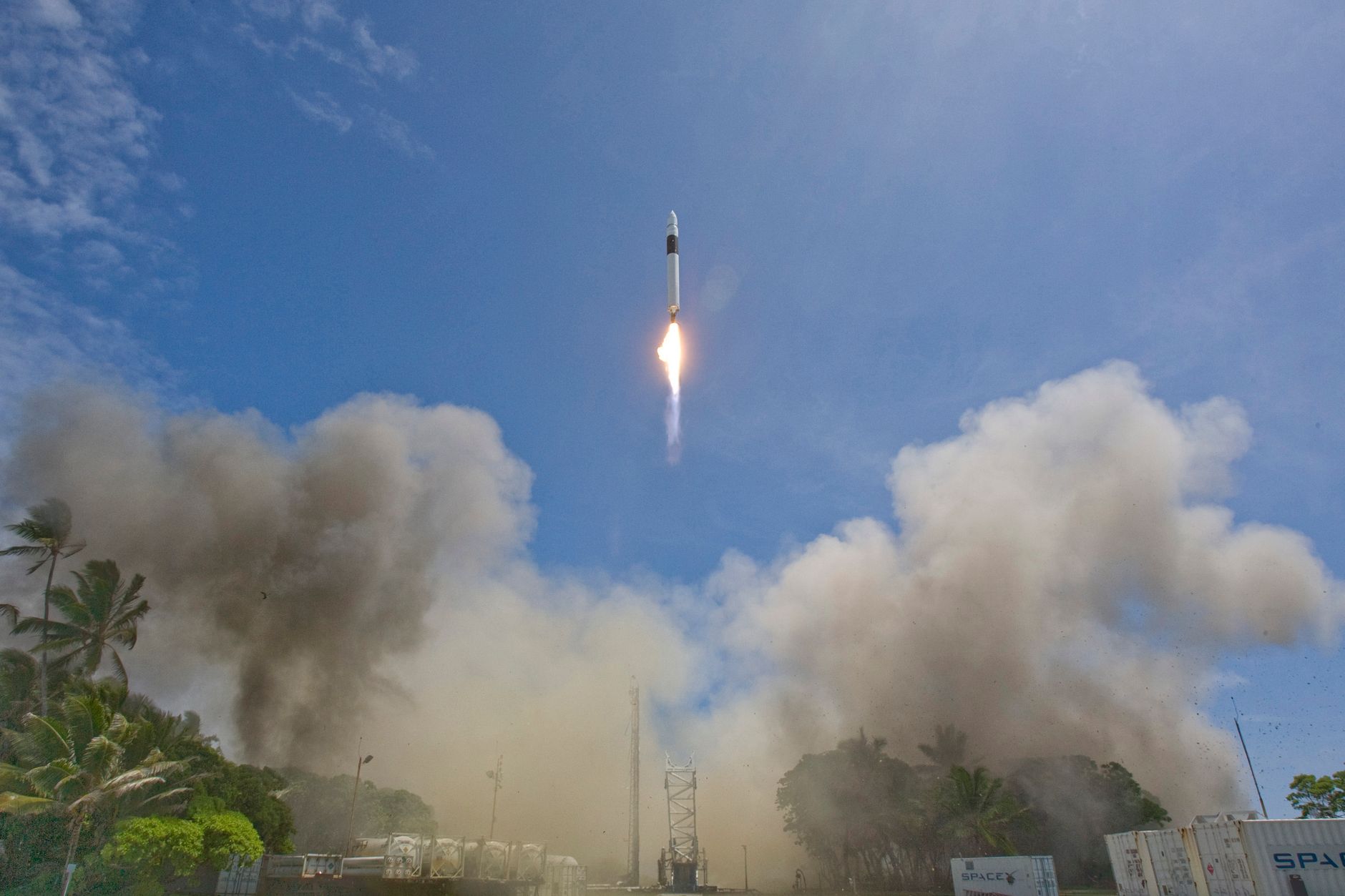
A SpaceX Falcon 9 booster completed its 35th orbital flight this morning, deployed 29 Starlink satellites from Cape Canaveral, and landed on a droneship off the Florida coast, marking the first time any orbital rocket booster in history has reached that reuse count. Booster B1067 lifted off at 6:13 a.m. EDT on June 8, 2026, after a 70-day turnaround from its previous flight. The milestone itself is simple: a piece of aerospace hardware flew to space 35 times and returned to land 35 times. What makes it significant is that no competitor booster has exceeded 15 flights, and no aerospace engineer outside SpaceX's propulsion group publicly expected an orbital vehicle to reach 30 reuses without retiring for major overhaul.
B1067 debuted in June 2021 on the CRS-22 cargo mission, then flew the Crew-3 astronaut flight, one European Hotbird satellite launch, one Galileo satellite deployment, and 23 Starlink missions. The booster has lifted roughly 1.2 million pounds to orbit across five years, carried both crewed and classified national security payloads, and kept its nine Merlin 1D engines operating within design parameters throughout. SpaceX's own SEC filing states the company engineered Falcon 9 boosters to support up to 40 flights, but conservative accounting estimates 25 as the useful life, B1067 has already exceeded that figure by 40 percent. The booster is now five flights shy of SpaceX's design ceiling and still operationally manifested.
The real significance is not that one booster reached 35 flights. It is that SpaceX now operates a fleet of boosters routinely reaching 15-plus reuses, with a systematic path to 30-plus, while every other orbital launch provider still struggles to achieve a single successful refly. Blue Origin's New Shepard has made multiple suborbital flights, but its orbital New Glenn booster had completed three orbital missions before it was destroyed during a pre-launch static fire test on May 28, 2026. Rocket Lab's Electron can be reflown but lacks the payload capacity or infrastructure to absorb the maintenance cost; Europe's Ariane 6 is not designed for reuse; Russia's Soyuz relies on solid-core returnability but at lower reuse rates. Japan's H3-30 variant launches June 10 as an expendable configuration, but zero flights have yet completed. No competitor has a deployed, flight-proven booster fleet approaching B1067's reuse envelope.
The economics of this divergence are non-trivial. Each flight of B1067 carries the full development and manufacturing cost of the vehicle amortized across 35 missions instead of one. At Starlink's launch pricing, roughly $15 million per flight, a vehicle that costs $60 million to build and maintain nets $525 million in gross revenue across its life. That math allows SpaceX to undercut competitors on marginal cost without sacrificing margin; it also funds the next generation of infrastructure (Starship, larger payload fairings, faster turnaround facilities) without waiting for external capital. Competitors operating single-use or low-reuse boosters cannot compete on that timeline or cost structure.
B1067 will likely complete another five flights before retirement, the booster is already manifested through late 2026, which means a single aerospace asset could eventually retire with 40-plus flights on the manifest. That outcome would prove SpaceX's engineering assumptions correct and move the entire industry's baseline expectation from 'single-use rocket' to 'multi-decade vehicle platform.' Watch three markers: whether B1067 reaches 40 flights without unplanned maintenance downtime of more than 30 days (proving turnaround scaling); whether a second SpaceX booster (B1066 or B1068) reaches 30+ flights by year-end 2026 (proving the 35-flight milestone was not a statistical outlier); and whether any competitor successfully reflies an orbital booster more than 10 times in the same calendar year (the competitive gap is closing, but slowly).