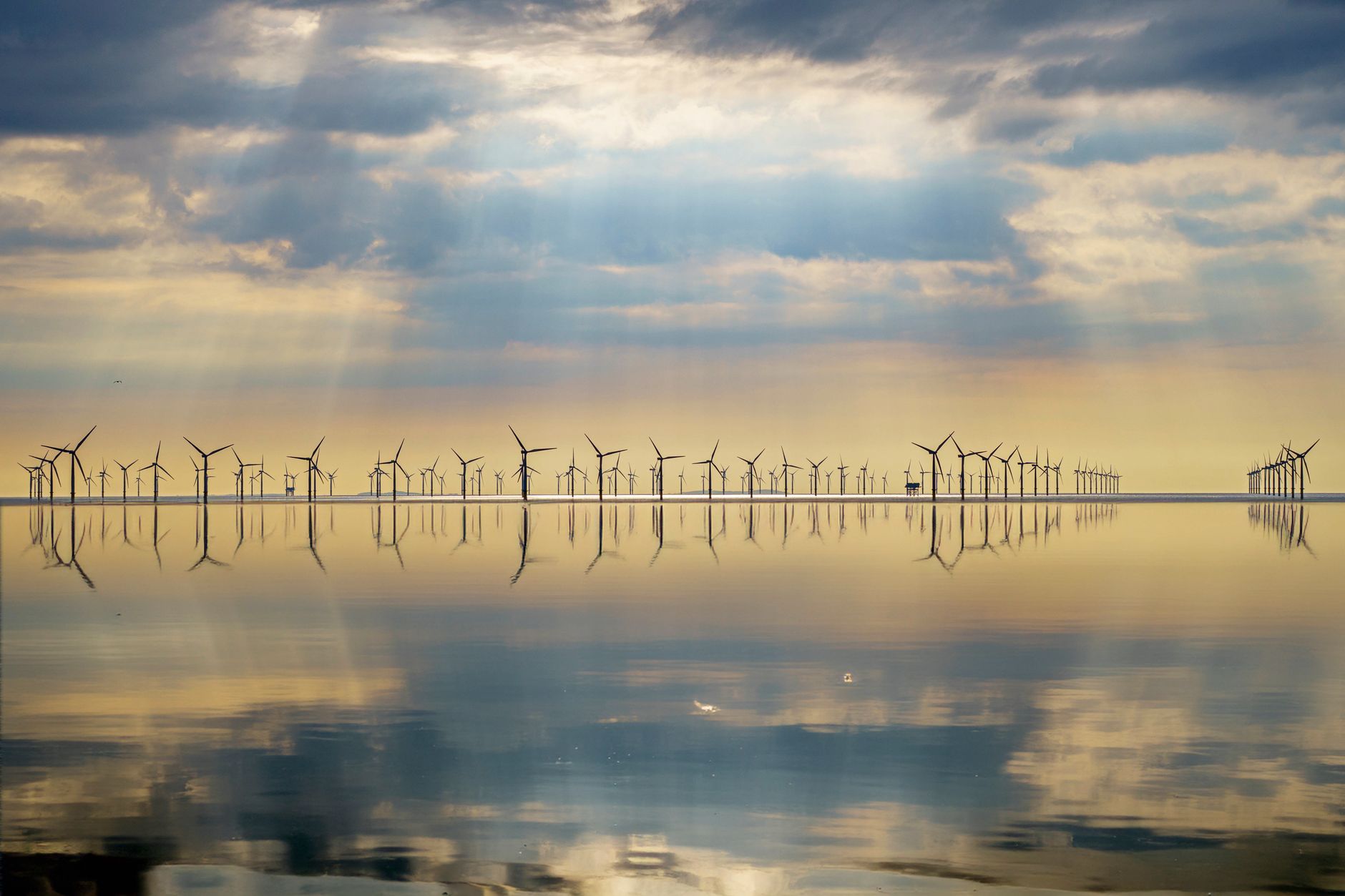
The UK's Low Carbon Contracts Company formally signed Contracts for Difference with all winners of Allocation Round 7 on March 26, 2026, locking in 8.4 GW of offshore wind capacity across more than 200 projects and unlocking an estimated £22 billion in private sector investment — the largest single procurement of offshore wind capacity in any auction round the country has ever run.
This matters because the UK's CfD scheme has spent the better part of three years rebuilding credibility it lost when AR5, in 2023, returned zero offshore wind bids after government-set strike prices failed to clear the market. AR6 partially recovered that ground — 3.8 GW of fresh capacity — but left the pipeline anxious. AR7's 8.4 GW is more than double AR6's offshore haul and exceeds the previous record of 7.0 GW set in AR4. Beyond the domestic arithmetic, a TGS|4C Global Market Overview published the same day placed the AR7 result in planetary context: the round alone made 2026 the fifth-largest year on record for global offshore wind offtake contracts in Q1 alone, and the full-year global pipeline — estimated at 19.6 GW — could surpass 2024's prior record of 19.1 GW.
The headline winner is RWE, which secured CfDs for approximately 6.9 GW of offshore wind across four projects — Norfolk Vanguard East and West, two Dogger Bank South tranches, and Awel y Môr — at a strike price of £91.20/MWh. That concentration, roughly 82% of the round's entire offshore wind volume under a single developer, is a supply-chain and execution risk that analysts have flagged, though RWE's existing presence at Dogger Bank and its Norfolk and Welsh consenting positions do reduce permitting uncertainty. SSE secured a CfD for 1.4 GW from Berwick Bank B at £89.49/MWh, the lowest strike price in the offshore wind tranche. Floating wind also cleared for the first time at commercial-adjacent scale: the 100 MW Erebus project in the Celtic Sea and the 100 MW Pentland in Scotland both secured contracts at £216.46/MWh — a price that reflects where floating technology sits on its cost curve, not where proponents expect it to land. (For comparison, that is 2.4 times the fixed-bottom weighted average; the gap is the entire argument for continued floating wind investment.) The broader AR7 result included 4.9 GW of solar, 1.3 GW of onshore wind, and 21 MW of tidal stream across a total onshore technology haul of 6.2 GW, all within a final budget of £1.79 billion — the government extended its original £1.1 billion budget to accommodate the volume of competitive bids.
The fixed-bottom offshore wind weighted average strike price of £90.91/MWh carries a number that deserves to be stated plainly: the cost of building and operating a new gas-fired power station in the UK is £147/MWh. Offshore wind in AR7 is 40.0% cheaper, by the government's own published comparison. That figure does not resolve every system-cost argument about intermittency and backup, but it does close the debate about whether offshore wind can compete with gas on raw generation economics at scale.
Dan Sadler, Director of Scheme Delivery at the LCCC, said 'Allocation Round 7 demonstrates the continued strength of the Contracts for Difference scheme in delivering low-carbon power and reducing our reliance on global fossil fuel markets. LCCC's role is to provide certainty and stability over the long term and we are proud to act as a reliable counterparty for these contracts, supporting projects from signature through to operation and beyond.' Martin Pibworth, Chief Executive of SSE plc, said 'We are delighted Berwick Bank B has been successful in AR7 and has secured a CfD for 1.4 GW of essential new low-carbon power for the UK at a competitive price for consumers. This milestone enables us to advance the project towards a final investment decision.' Ben Backwell, CEO of the Global Wind Energy Council, said the results mean 'offshore wind is back with a bang,' adding that the auction 'shows firm backing for offshore wind and the fundamental role the technology plays in powering the UK's economy and moving decisively to ensure the country's energy security.' Ivar Slengesol, Managing Director and VP at TGS|4C, framed the geopolitical dimension directly: 'The Iran war and the resulting oil and gas supply reductions have reminded countries dependent on fossil fuel imports about their energy vulnerabilities. The offshore wind industry will be looking to see if a renewed focus on energy security will translate into political actions that accelerate site and offtake awards, permitting, and — ultimately — large-scale projects generating renewable energy.'
For developers, grid operators, and supply-chain manufacturers, the implications of AR7 are immediate and uneven. RWE now holds a project portfolio requiring execution at a scale and pace that will stress UK port capacity, cable manufacturing, and installation vessel availability simultaneously. SSE's flagged FID for Berwick Bank B is the next discrete decision point to watch. For the broader market, with the CfD scheme now having contracted more than 47 GW of renewable electricity across all technology types — 10 GW of which was already in operation as of November 2025 — the UK's trajectory toward its 43–50 GW offshore wind target by 2030 looks more credible than it did eighteen months ago, though the arithmetic still requires at least 12 GW more capacity contracted through AR8 and beyond. Globally, the TGS|4C data shows a 17.0% year-on-year decline in the 2030 non-China offshore wind installation forecast, from 145 GW to 120 GW — a reminder that record auction volumes and shrinking build forecasts can coexist in the same market cycle. AR7 is a signal of confidence. The 2030 forecast revision is a signal of execution risk. Both are true at once.
Three signals are worth tracking closely. First, RWE's project-level FIDs across its 6.9 GW portfolio: the concentration of capacity under one developer means any hesitation at a single project ripples through the entire round's delivery profile. Second, the UK government's AR8 timeline and budget, which must be set against a National Energy System Operator modelling range of 43–50 GW by 2030 — the gap between current contracted capacity and the lower end of that range leaves almost no room for another failed round. Third, floating wind's cost trajectory: Erebus and Pentland are contracted at £216.46/MWh today; the question for the next CfD cycle is whether commercial-scale deployment in the Celtic Sea and Scottish waters can begin to bend that curve toward something that does not require a separate strike price bracket. What AR7 reveals, more than anything, is that the UK's offshore wind programme has recovered its institutional momentum — and that the harder work, turning signed contracts into spinning turbines, is only just beginning.