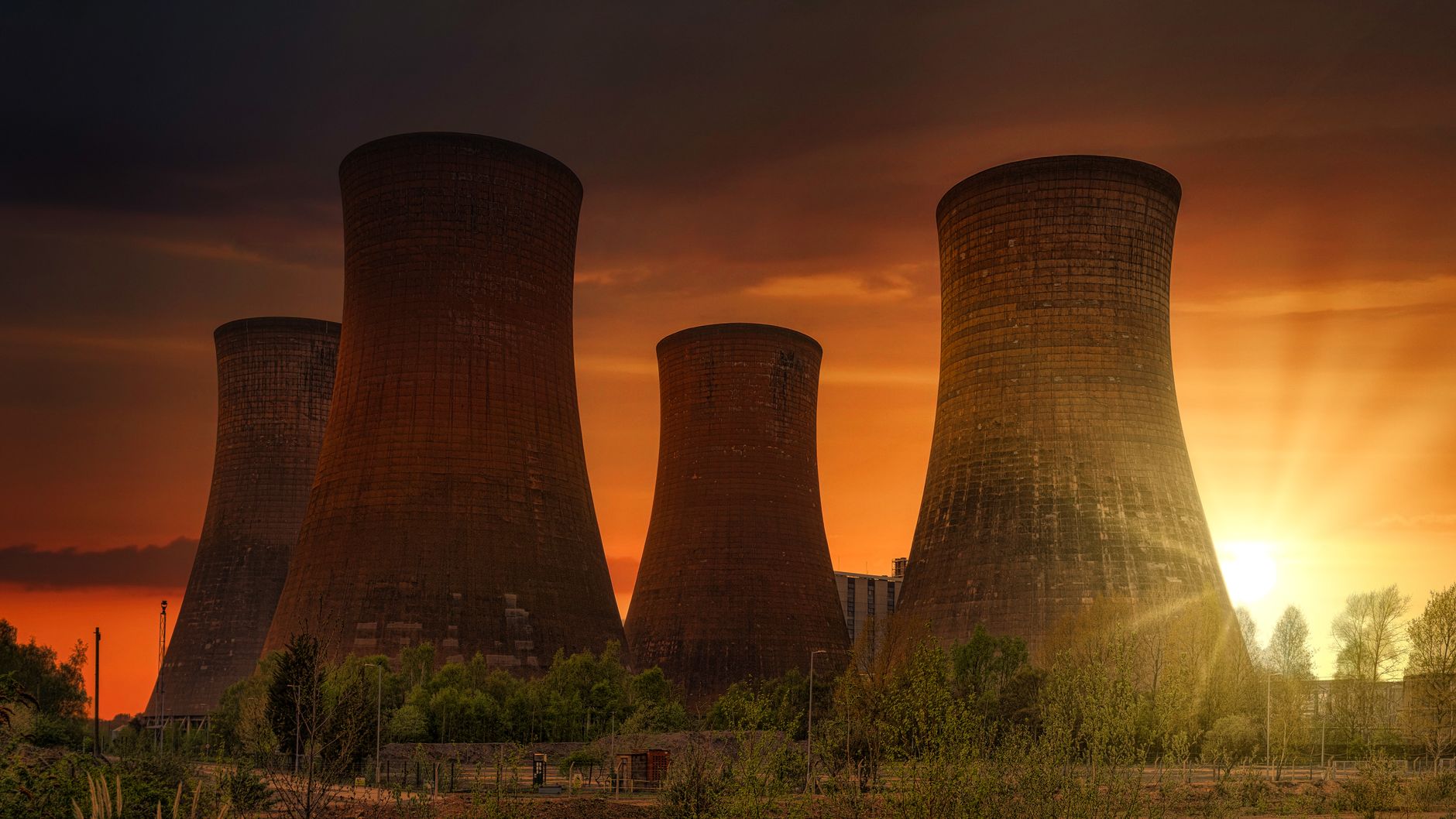
On the night of June 4, Uzbek workers began pouring concrete into the foundation slab of a small modular reactor in the Jizzakh region while Vladimir Putin and Shavkat Mirziyoyev watched via video link from St. Petersburg. This was not a ceremony for a signed contract or a regulatory approval, it was an actual construction start, licensed that same day by Uzbekistan's Committee for Industrial, Radiation and Nuclear Safety. The IAEA Director General, Rafael Grossi, delivered his address to the ceremony participants remotely from Samarkand, where he was attending a separate summit. One hundred thirty-three cubic meters of concrete went into the first stage; the full foundation pour will exceed 10,000 cubic meters. For the first time anywhere in the world, a small modular reactor export order had moved past design, financing, and permitting into the physical act of building.
The plant Uzbekistan is building combines two 55 MWe RITM-200N reactors, Russian-designed, purpose-built SMRs, with two larger 1,000 MWe VVER-1000 reactors on a single site, creating 2.1 GW of combined capacity. The base contract price sits at $9.5 billion. That works out to roughly $4.5 billion per gigawatt of installed capacity, cheaper than the most recent U.S. large-reactor projects (which run $8–12B per GW in current dollars) but substantially more expensive than coal or natural gas plants built to the same timeline. The money has not all materialized, Tashkent is targeting 85–90% external financing, likely from the New Development Bank or concessional Russian export loans. Rosatom, the state enterprise building the plant, has committed to supply the reactors. Uzbekistan committed to buying the electricity and absorbing the construction and operational risk.
What makes this moment significant is not the reactor design, RITM-200N units have operated in Russian icebreakers for years and are proven, low-risk technology. It is that Uzbekistan is now the template. Every other SMR vendor in the world, NuScale in the U.S., GE Hitachi, Rolls-Royce in the UK, China's ACP100, has been stalled at the design-finalization or early-permitting stage. None has poured concrete. None has a construction license from a third-country regulator. Rosatom did, in a country that is neither Russia nor a close Russian ally, with IAEA blessing, in a region (Central Asia) where Western vendors have almost no geopolitical foothold. That combination, proven design, external financing, third-country execution, and IAEA validation, is exactly the playbook that every Western SMR company has been claiming was imminent. Uzbekistan got there first with a Russian partner.
The first RITM-200N unit is scheduled for criticality in late 2029, just over three years from now. That is the hard milestone. If that date slips by more than a year or two, the entire narrative around SMR construction timelines and cost discipline collapses; if it holds, Rosatom has a template for secondary orders across the Middle East and Africa. The two VVER-1000 reactors come later, in 2033 and 2035. Once fully operational, the site is expected to generate more than 15 billion kilowatt-hours of electricity annually, up to 14% of Uzbekistan's current power consumption. That is not marginal; it is strategic infrastructure. Tashkent will have handed control of one-seventh of its electricity supply to a nuclear facility financed and built by a Russian state enterprise. For Rosatom, that is not a single contract. It is proof of concept. For every other SMR vendor watching this pour, it is a shot fired.
Watch three things. First, the criticality date for the first RITM-200N, any slip beyond late 2030 signals cost overruns or supply-chain friction. Second, whether the New Development Bank or Asian Development Bank approves the financing in the next six months; rejection or delay would indicate geopolitical or technical hesitation. Third, whether Rosatom announces secondary SMR orders, for Kazakhstan, Tajikistan, Turkey, or the Middle East, within 18 months. That will tell you whether this is a unique deal or the opening of a new export vector.